
 It's weird. NASA the other day released potentially some of the most interesting findings ever discovered by mankind, yet the news has shown very little interest in it. The Curiosity Rover which landed on Mars back in 2012 has been roaming around drilling core samples for a while now, but NASA now say that they are getting what they call 'spikes' in methane detection, increasing up to ten times the normal amount.
 At the moment Scientists are unaware of where exactly these methane spikes are coming from. It could be trapped wind (sorry, gas) escaping rock. It could be by some process the sun is having on other elements in the atmosphere, but most interesting is the idea that it is actually coming from basic lifeforms that are still alive. (Here on Earth just to put this into context, 95% of all methane in our atmosphere comes from microbial lifeforms.)
A team member from Curiosity is now saying that the chances of life on Mars are at 50/50. I suspect that they have the answer already though as about a year back (although I can find no reference to it now) there was a team member who said something a long the lines that they'd made 'the greatest ever discovery' only for very little information to come out. Why would they do this? Well because it would fundamentally change our entire outlook on our own existence and could start severe societal changes I guess.
Over the last few years, the data collected by NASA's Martian Rovers has continued to shed light on the conditions that were present on the red planet before it became a desert. The hypothesis that Mars was once a wet and warm environment have largely been proven correct. All evidence seems to be pointing towards the idea that Mars once had a water cycle almost identical to what Earth's is today, where water from Glaciers formed rivers and flowed into great oceans.
Liquid water is of course one of the biggest give ways that life may have existed on Mars at some point in the past, but it is not the only scrap of evidence that supports the theory. Within the dry Martian landscape where great rivers and lakes once existed, the Martian rovers have discovered that within the ancient clay lies complex minerals such as magnesium and boron, essential for the building of RNA and DNA. Through the rover's on board lab it also appears as though the water had a neutral PH balance, and this would have most likely provided a habitable environment for basic microbes.
 The only issue with the idea of life originating on Mars is that if life did evolve there, it would have had to have acted quite quickly as it is thought that it's atmosphere was lost quite rapidly after the planets formation. The atmosphere seems to have been lost mainly due to it's smaller size when compared with Earth. Its smaller size meant that its internal temperature cooled quickly, causing the loss of its liquid magma core. This loss of a free-flowing inner core meant that the Martian magnetosphere was severely impaired, exposing it's atmosphere to the full onslaught of the solar winds. Over many years, these solar winds stripped the planet of it's atmosphere and thus, the water once abundant on the surface was lost to space. There are also other theories about how the Martian magnetosphere was lost such as the theory that it was a quick succession of asteroid strikes, rock absorption of gases or perhaps a perfect storm of all of these put together.
So despite evidence suggesting that conditions were at the very least possibly favourable to life's development, what connects life on Earth with that of Mars, and how could Mars be our ancestral home?
The answer lies with a theory called 'Panspermia'. Whilst the name sounds like it's something to do with ejaculating on the faces of more than one person at a time, it is actually a theory that life is seeded throughout the cosmos by pigging backing on space rock and ice to new destinations. Whilst the theory has very little concrete evidence, many in the Scientific community such as Stephen Hawking believe that it could be a viable answer, and there are some signs which suggest that it has some truth to it.
The evidence about life beginning on Mars comes from an asteroid known lovingly ALH84001, found in Antarctica in 1984, it still remains a hot subject among scientists and the public alike. The reason for the interest comes from small 'fossils' which were found embedded in the rock which resemble basic lifeforms, and considering this rock has reportedly come from Mars over 15 million years ago (the rock having been formed 4 billion years ago during the Martian wet period) it is certainly interesting to consider the possibility that life throughout the cosmos is abundant, and strangely, mobile.
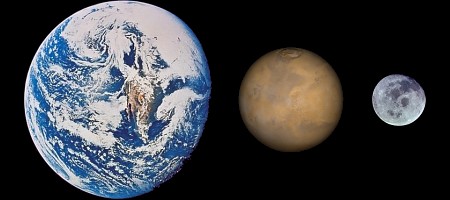 |
| Mars is considerably smaller than Earth, and is the main reason for its sterile environment. |
Oddly, the asteroid sample from ALH84001 was found to have not heated internally during entry into Earth's atmosphere. As the rock became superheated externally, the metallic components inside the rock actually created a mini-magneto effect which shielded the rest of the rock from the intense heat internally. If an extremophile organism was present inside a Martian meteorite then it is quite conceivable that it would have survived the relatively short journey from Mars to either begin life on or diversify basic microbes here on Earth.
In this study it suggests that rocks coming from Mars to Earth may have been a regular occurrence over the solar systems history (Earth rocks making a Mars bound journey would have been much more difficult due to Earth's greater gravitation.) We also have to accept that Mars would have settled and cooled sufficiently much quicker than Earth after formation, giving life a bit of time to get ready to make the journey here, adding yet another logical point to this idea.
(Having made the point about space debris being a one way ticket from smaller planets however, there was this one article from the Independent. Ejected Earth rock may well be possible then, but it just needs to nearly wipe out life in the process.)
Scientists have now even begun to look into the Martian dryness (even when Mars was wet it was not as wet as Earth) as a sign that life here may have started there. Confused? In short, certain elements in the cocktail of ingredients needed to create life actually need dry conditions to form. Although Mars was generally a wet planet in its early conception, there were large parts of dry desert too, and this is where many of those fundamental elements were cooked up. Now there is evidence to suggest that those elements could not have existed here on Earth early on, which goes against the timeline in life's first appearance here on Earth.
Last year many newspapers and news outlets ran the story about the possibility of Mars being our ancestral home (have a read of the BBC, National Geographic ones,) but this doesn't explain where life came from on Mars first either. There are two other interesting things to consider which back this Panspermia idea, which does not have anything to do with Mars per se.
Firstly is the discovery of sugar in space, with news reports back in 2012 reporting that they were abundant around young sun-like stars. It may indicate that life may simply be a normal component in a solar systems creation (sugar is a major building block in RNA.) Secondly is an idea which originally applied to technology, 'Moore's Law'. It was suggested last year that by working backwards in complexity, life ought to be ten billion years old, if of course it increased in complexity in any organised manor. (Which it probably doesn't.) All things considered however, it is interesting that science is now beginning to take the idea of life being seeded here as a serious concept.
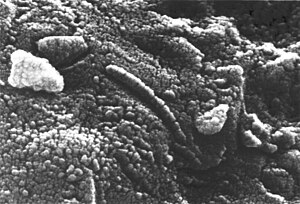 |
| The 'fossils' as seen inside the Martian asteroid sample. |
In all seriousness though, if we are on the cusp of meeting an ancient ancestor, I think it will have a profound influence on our psyche. If the DNA or RNA is similar enough, it will jog us from this feeling of un-connectedness (if that is a real word) and into the realisation that actually we are a part of not only this planet, but of the entire universe. Be us human, animal or plant, we are all essentially the same, and perhaps this may well usher us into managing our own ecosystem a little better. Sure, the real religious nuts would go ape-shit, but then when have they ever not gone mental?
In conclusion then, we may all very well have Martian ancestors, who came here on the back of a meteorite after a violent explosion on the red planets surface. At the moment, although there are no ways to prove these theories, it does resonate with a certain degree of logic that life acts on a cosmic scale in much the same way that life does here on Earth. In fact it would not be at all surprising to me at all if extremophile organism's actually exist out there on comets etc, with their entire purpose being simply to find other planetary bodies to deposit life onto.
Life as a whole very well may actually see itself, strangely, as a single organism, navigating the universe the best it can through trial and luck. Things can get philosophical real quick with this stuff!

